Sylvie and Jean-Luc's Ordeal in the Easter Village
Cartes Postales from GreeceSylvie and Jean-Luc's Ordeal in the Easter Village is an embedded episode in the narrator's account of travelling through Greece. A seemingly ordinary problem—a car without petrol and the need to find somewhere to sleep—draws the newly married couple into a village whose welcome conceals a violent local rule. Sylvie escapes the room where they are held, but Jean-Luc disappears. Her account is eventually believed by hospital staff, yet the lack of a body or other proof turns her into a suspect rather than a witness whose story can be confirmed.
A stop in a village that does not welcome visitors
The narrator's encounter with the village establishes a contrast between picturesque appearance and social hostility. After leaving Thessaloniki, the narrator travels south along the east coast and visits a fishing settlement reached by a rough track through meadows and crops. The place appears exceptionally beautiful, with a sheltered harbour, colourful boats, a sandy cove, pine trees and old olive trees on the hills. Yet the seafront restaurants seem to serve local residents rather than travellers, and the narrator finds neither the usual tourist goods nor any hotel, guesthouse or room sign. The village's beauty offers no guarantee of welcome.
At a nearby town, a hotel owner reacts with alarm when the narrator names the place and explains that people avoid it because something terrible is said to have happened there. The account of Sylvie and Jean-Luc supplies the history behind that warning. Their ordeal is not an unrelated danger encountered on an otherwise scenic route: it makes the village's refusal of hospitality and the local reputation intelligible. A place that appears ready-made for a postcard becomes, in the narrator's telling, a community whose boundaries are guarded by an unwritten law.
From roadside trouble to confinement
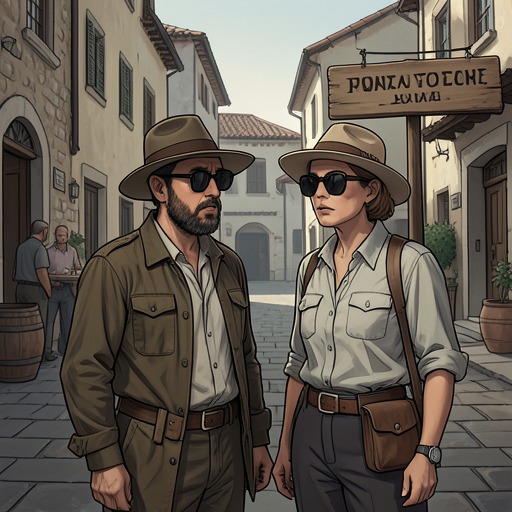
Sylvie and Jean-Luc are stranded when their car runs out of petrol, with no immediate way to continue their journey. Seeing a light in the general store, Sylvie goes in to ask about a room or petrol. The shopkeeper, seated at the till, appears to be expecting her. When Sylvie explains that the couple are stuck until morning, the woman recommends a room at the police station while looking at Jean-Luc. He recognizes that Sylvie had been there earlier, but the couple have few alternatives; tired, she persuades him to accept the suggestion.
The shopkeeper leads them upstairs into a room with two single beds and a sink. At first it appears to be a simple place to spend the night. Later, when a door opens, Sylvie sees that bars have been slid across it, flush with the wall so they were not apparent before. Jean-Luc recognizes that they are in a cell and that a padlock prevents their exit. Their situation changes abruptly from inconvenience to deliberate confinement, but neither knows what they are supposed to have done or why they have been locked in.
Jean-Luc looks for another way out. An air-conditioning vent high in the wall seems large enough for Sylvie, though not for his broader frame. The only way to reach it is to make a ladder from the metal bed frames. With great effort, he stacks the beds and ties them together using the blankets. Sylvie is frightened and initially cannot bring herself to climb. At his urging, she finally hoists herself into the narrow opening. She disappears from his view, leaving him alone in the cell; on the other side of the wall, she falls onto a balcony and gathers herself to continue.
The Easter ritual and Jean-Luc's disappearance
Sylvie finds the street deserted and works out a route along the balconies to reach the ground. In the dark, she tries to navigate the village towards the sea. On the way she falls and is injured, and, as her hand begins to swell, removes her wedding ring and puts it in her jeans pocket. The ring will later become important in the official interpretation of her story. She eventually reaches a group of people gathered by the water, where she notices a child pointing towards a light in the sky.
A fuse travels out from the far side of the harbour, and an explosion sets alight a structure on an island in the water. As the flames rise, Sylvie can make out a scaffold and a hanging effigy. She remembers having read about the burning of Judas on Holy Saturday, but what she sees is more disturbing than a simple figure in a fire: its shape recalls Jean-Luc. Fireworks and bangers accompany the spectacle, while people along the waterfront light candles from one another. One woman hands Sylvie a candle and shares the Easter greeting; Sylvie does not understand its religious significance or that the flame is believed to have come from Jerusalem.
The episode brings the public celebration and the couple's private danger into collision. The crowd's candles and the effigy belong to an established Easter observance, but the figure on the gallows-like structure makes Sylvie fear that the village's ritual has reached beyond symbolism. She watches it burn, increasingly distressed by its resemblance to her husband. As the wind shifts, a smell of cooking meat reaches her, intensifying her shock; the narrative does not establish that the effigy is Jean-Luc, and Sylvie herself has no way to verify what she has seen. The uncertainty is central to the ordeal: the spectacle gives her reason to fear the worst without giving her proof.
Investigation, local custom and unresolved loss
When Sylvie gets back to the police station, the room has been restored. The beds are neatly arranged, the vent is back in place, and there is no sign that anyone has slept there. Jean-Luc is gone. The apparent erasure of their stay leaves Sylvie with no material evidence of the confinement and no explanation for his disappearance. She leaves the village, but her injuries and the shock of what has happened make escape difficult; a farmer eventually gives her a lift to a larger town.
At the hospital, a doctor who speaks French translates her account for other doctors and nurses. They believe her, and explain the local rumours: in past centuries, villagers used Holy Saturday to hang a criminal, and the custom has been reinstated. Sylvie and Jean-Luc, they conclude, were in the wrong place at the wrong time and had intruded upon one of the village's unwritten rules. This account gives a possible cause for their treatment, but it does not establish Jean-Luc's fate. No corpse, witness or other evidence supports Sylvie's story, and the local police and residents close ranks.
The missing wedding ring further undermines her position. Because it disappeared only days after the wedding, authorities interpret its loss as possible evidence of a serious altercation between the couple. With no body, murder cannot be proved, but the absence of proof does not clear Sylvie; she remains under investigation. The Greek press briefly fixates on the case, then forgets it after the trial. Later, two simple wedding bands appear in the window of the village shop, placed among ordinary goods. Their presence quietly returns the unresolved marriage to the setting where it was broken, without explaining who put them there or what happened to Jean-Luc.
For the narrator, the story transforms the meaning of a visit to the harbour. Having eaten dinner overlooking the same water, the narrator is chilled by the account and has a nightmare about Jean-Luc. The narrator later spends Easter in a mountain village, welcomed by strangers and included in their holiday, an experience that stands in sharp contrast to Sylvie and Jean-Luc's exclusion. The contrast does not make the ritual itself equivalent to the village's violence; rather, it shows how collective observance can be experienced as hospitality in one place and as a threat in another. In this episode, the public Easter celebration cannot restore the couple's safety, and the closed community preserves its custom while leaving the visitor alone with an account no evidence can settle.